Southeast Asia is emerging as one of the world’s fastest-growing digital infrastructure markets, and Malaysia is quickly becoming the center of that momentum.
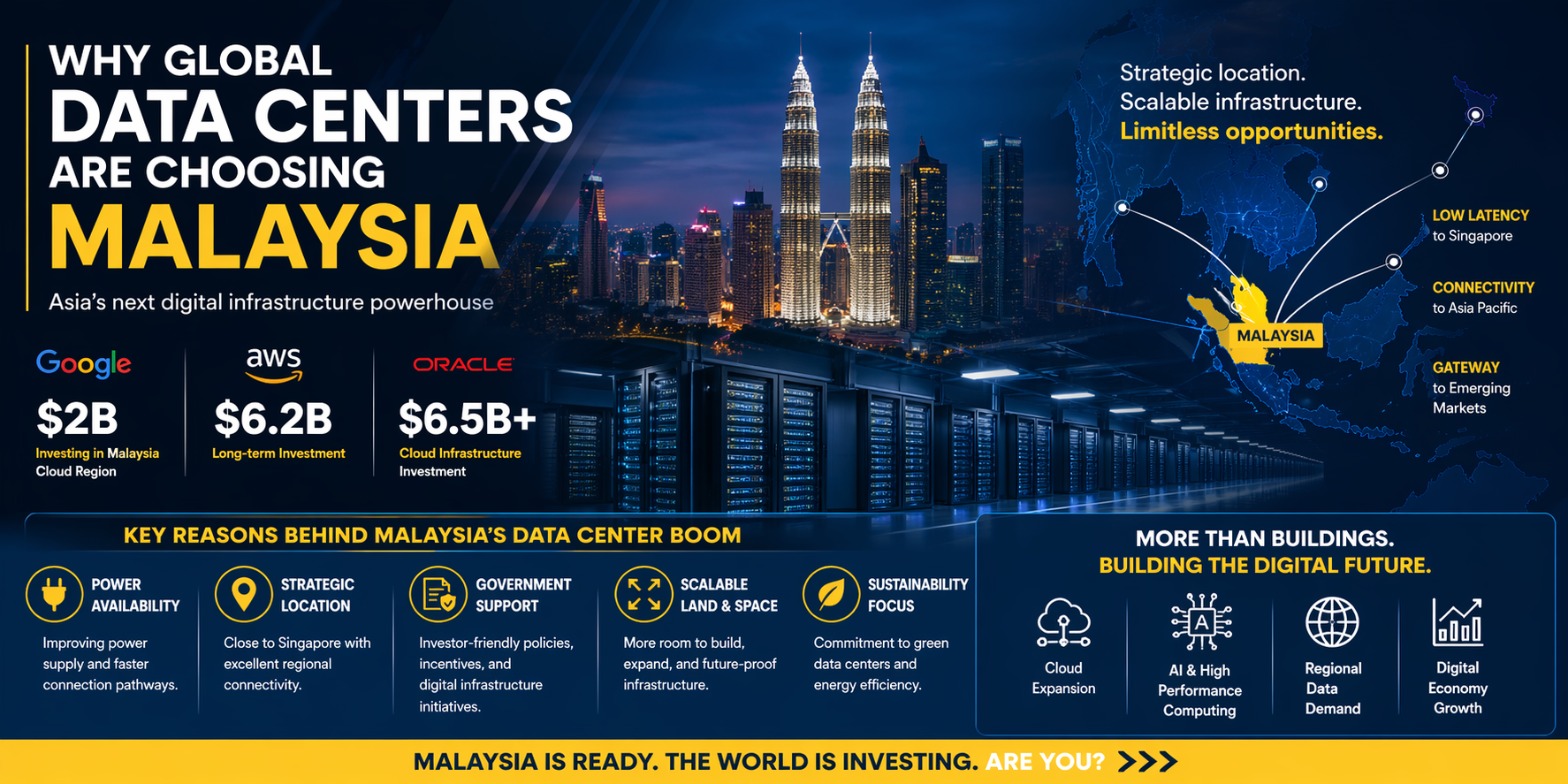
Over the past two years, global hyperscalers such as Google, AWS, and Oracle have announced multi-billion-dollar investments in Malaysian data center and cloud infrastructure projects. These are not short-term experiments—they are long-term strategic deployments designed to support the next wave of cloud computing, AI workloads, and regional digital growth.
For infrastructure providers, this shift creates a significant opportunity. As more hyperscale facilities are built, demand rises not only for land and energy, but also for the fiber connectivity, structured cabling, and deployment-ready network infrastructure required to support these projects.
Malaysia’s rapid rise in the data center sector is being driven by a rare combination of policy support, power accessibility, land availability, and regional connectivity.
Unlike saturated markets where power constraints and land shortages delay deployment, Malaysia offers a more scalable environment for digital infrastructure investment. Government-backed initiatives aimed at accelerating digital ecosystem development have made the country increasingly attractive for hyperscale cloud providers.
Another major advantage is its strategic proximity to Singapore, the region’s most mature data center market. As Singapore faces increasing land, energy, and environmental limitations, neighboring Malaysian regions—especially Johor—have become ideal locations for spillover capacity.
For global cloud operators, Malaysia provides something increasingly difficult to find in Asia:
A market where hyperscale infrastructure can still scale efficiently.
The strongest driver behind Malaysia’s growth is the rapid rise in cloud demand and AI infrastructure requirements.
Traditional enterprise workloads are being replaced by:
AI training clusters
GPU-intensive computing
Cloud-native applications
Regional cloud zones
Edge data deployments
These workloads require high-density, low-latency, and scalable infrastructure environments, which in turn require massive investments in:
power systems
cooling architecture
fiber backbones
structured cabling networks
As hyperscalers expand capacity, the need for robust physical infrastructure becomes even more urgent.
This means suppliers of fiber optic cabling, patch panels, rack connectivity systems, and interconnection solutions are positioned to benefit directly from Malaysia’s data center expansion.
Not all Malaysian regions are growing equally. Current investment is concentrated in areas with the strongest infrastructure readiness.
Johor is becoming Malaysia’s most strategic hyperscale deployment zone due to its direct connectivity to Singapore. It offers:
lower latency routes
larger development land parcels
greater long-term scalability
This makes Johor ideal for AI-ready and hyperscale data center campuses.
These regions remain central for enterprise cloud services and mature digital ecosystems. Their advantages include:
stronger enterprise demand
mature network ecosystems
skilled technical talent
These locations are attractive for cloud service nodes and enterprise-grade data center deployments.
Every new data center project creates downstream demand for physical infrastructure.
While public attention often focuses on land acquisition and energy supply, the actual deployment of a data center depends heavily on network interconnection infrastructure.
This includes:
fiber optic trunk links
high-density patch panels
ODF systems
rack cabling assemblies
structured cabling solutions
Without reliable interconnection architecture, data center scalability and performance are limited.
As Malaysia accelerates data center development, infrastructure suppliers who can deliver deployment-ready fiber connectivity solutions will play a critical role in supporting new builds and capacity expansion.
Malaysia’s data center boom is not just a regional investment trend—it is a supply chain opportunity.
As hyperscalers and colocation providers build new facilities, they need partners capable of delivering:
scalable fiber infrastructure
high-density connectivity products
rapid deployment support
customized interconnection solutions
This creates opportunities for manufacturers and solution providers in:
fiber cabling systems
patch panels
ODF products
rack connectivity accessories
structured cabling solutions
For suppliers prepared to align with hyperscale deployment requirements, Malaysia represents one of the most important infrastructure growth markets in Southeast Asia.
Malaysia’s rise as a digital infrastructure hub reflects a broader transformation in the Asia-Pacific data center market.
Driven by AI demand, cloud expansion, and regional infrastructure spillover, Malaysia is becoming a strategic location for hyperscale deployments.
For infrastructure suppliers, this trend represents more than market growth—it represents a chance to become part of the next wave of digital infrastructure buildout.
Companies that can support scalable connectivity and deployment-ready infrastructure will be best positioned to benefit from Malaysia’s accelerating data center expansion.
Because Malaysia offers scalable land, faster infrastructure expansion opportunities, strong regional connectivity, and growing demand for AI and cloud infrastructure.
Johor, Cyberjaya, and Greater Kuala Lumpur are currently the leading regions for hyperscale and enterprise data center deployment.
Fiber optic cabling, patch panels, ODF systems, rack interconnection products, and structured cabling solutions are essential for scalable deployment.
Related Products
IP68 Fiber Optic Splice Closures — Designed to provide secure and reliable protection for fiber optic joints
Aug 02-2024

Enhancing Campus Connectivity: GJYXCH Fiber Optic Cable in Educational Networks
Jan 09-2024
Elevating Urban Infrastructure: GJYXCH Fiber Optic Cable in Smart City Networks
Jan 07-2024
 English
  français
  Deutsch
  Español
  italiano
  русский
  português
  العربية
  ไทย
ไทย  Polska
  română