As artificial intelligence workloads continue to scale, traditional data center infrastructure is being pushed to its limits.
At the center of this transformation is the AI rack — a highly integrated system designed to support extreme compute density, ultra-fast data movement, and advanced thermal management.
Unlike conventional server racks, AI racks are engineered as complete infrastructure units, where compute, networking, power delivery, cooling, and storage must operate in tight coordination.
This article breaks down the architecture of an AI rack and explains how each component contributes to high-performance AI workloads.
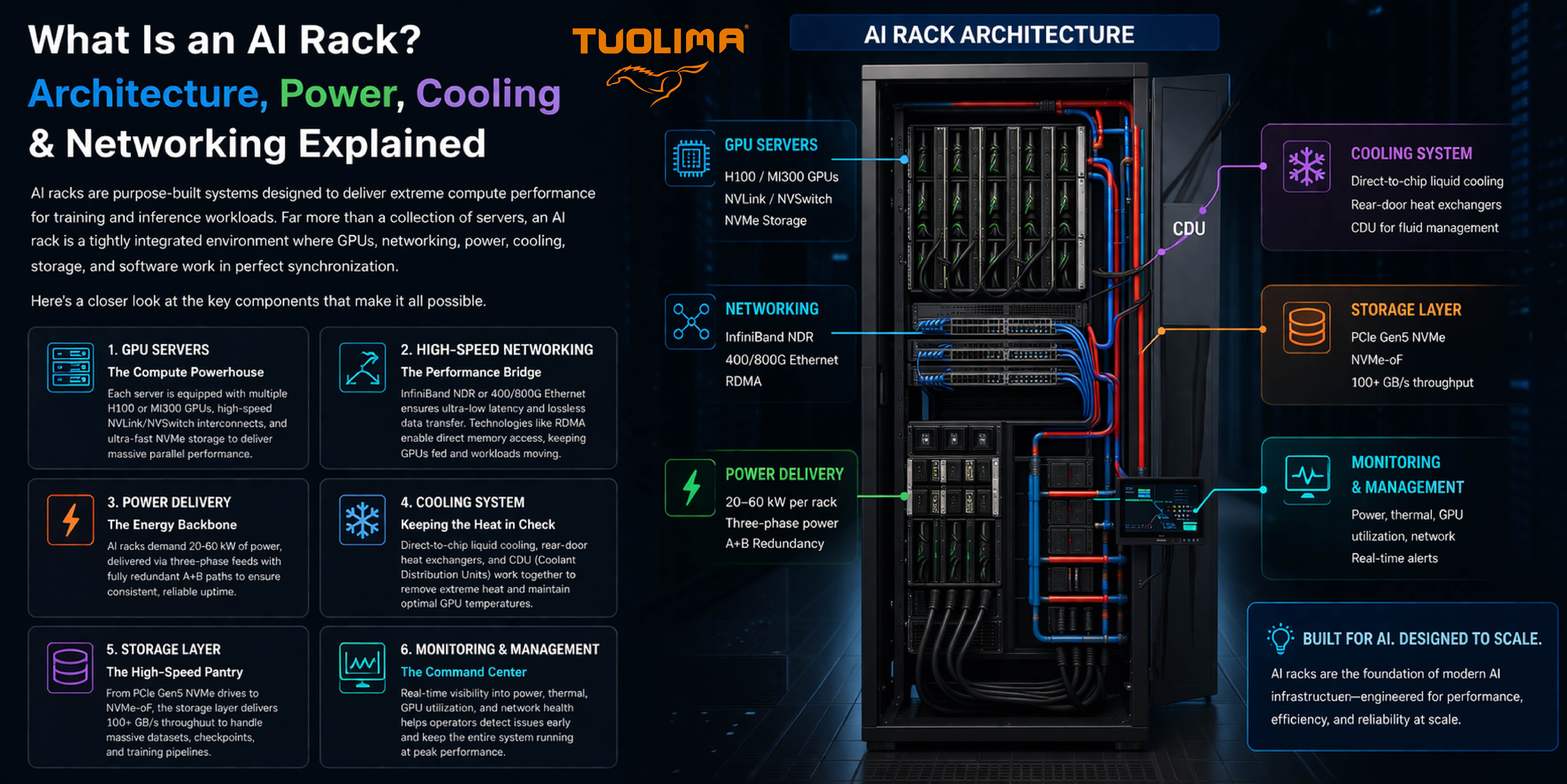
An AI rack is a high-density computing system specifically designed to support artificial intelligence training and inference workloads.
It typically includes:
GPU-accelerated servers
High-speed networking fabric
Advanced power distribution systems
Liquid or hybrid cooling infrastructure
High-performance storage systems
Real-time monitoring and management tools
Rather than functioning as independent components, these elements form a tightly coupled ecosystem optimized for throughput, latency, and reliability.
At the heart of every AI rack are GPU servers, which provide the computational power required for AI training and inference.
Modern AI servers are built with:
Multiple high-performance GPUs (such as H100 or MI300-class architectures)
High-bandwidth interconnects like NVLink or NVSwitch
Ultra-fast NVMe storage for local data access
These systems are designed for parallel processing at scale, enabling massive workloads such as large language models and computer vision training.
However, this performance comes at a cost — significant power consumption and heat generation.
One of the defining characteristics of AI racks is their power demand.
Typical configurations require:
20 kW to 60 kW per rack
Three-phase power input
Redundant A+B power paths
This level of power density requires careful planning of:
Power distribution units (PDUs)
Cabling infrastructure
Redundancy and failover mechanisms
In modern deployments, power is no longer just a utility — it becomes a critical design constraint.
AI workloads depend on fast and efficient data movement between compute nodes.
To support this, AI racks utilize:
InfiniBand (NDR and beyond)
400G / 800G Ethernet
RDMA (Remote Direct Memory Access) technologies
These technologies reduce latency and CPU overhead, allowing GPUs to communicate directly and efficiently.
In AI environments, networking is not just connectivity — it is an extension of the compute architecture.
As power density increases, traditional air cooling becomes insufficient.
AI racks increasingly rely on:
Direct-to-chip liquid cooling
Rear-door heat exchangers
Coolant Distribution Units (CDUs)
These systems remove heat more efficiently and maintain stable operating conditions for GPUs.
Without proper cooling, systems may experience:
Thermal throttling
Reduced performance
Hardware failure
Cooling is therefore a mission-critical component of AI infrastructure.
AI workloads generate and process massive volumes of data.
To keep GPUs fully utilized, storage systems must deliver:
PCIe Gen5 NVMe performance
NVMe over Fabrics (NVMe-oF)
High throughput (100+ GB/s in aggregated systems)
Efficient storage architecture ensures that data pipelines remain unblocked and compute resources are not underutilized.
Given the complexity of AI racks, real-time monitoring is essential.
Key metrics include:
Power consumption
Temperature and thermal distribution
GPU utilization
Network throughput and congestion
Advanced monitoring systems enable predictive maintenance and rapid fault detection, reducing downtime and improving operational efficiency.
An AI rack is not simply a collection of high-performance components.
It is a systems engineering solution, where:
Compute performance
Power availability
Thermal efficiency
Data movement
must be optimized together.
As AI workloads continue to evolve, data centers must transition from traditional IT infrastructure to integrated, high-density, and high-efficiency designs.
AI racks represent a fundamental shift in how data centers are designed and operated.
Organizations that adopt AI infrastructure must rethink:
Power capacity planning
Cooling strategies
Network architecture
Physical layer design
Those who successfully adapt will be better positioned to support the next generation of AI-driven applications.
Related Products
IP68 Fiber Optic Splice Closures — Designed to provide secure and reliable protection for fiber optic joints
Aug 02-2024

Enhancing Campus Connectivity: GJYXCH Fiber Optic Cable in Educational Networks
Jan 09-2024
Elevating Urban Infrastructure: GJYXCH Fiber Optic Cable in Smart City Networks
Jan 07-2024
 English
  français
  Deutsch
  Español
  italiano
  русский
  português
  العربية
  ไทย
ไทย  Polska
  română